
BUSINESS
The Journey of Defstaartup.org/


Have you ever dreamt of transforming a brilliant idea into a thriving business? Welcome to defstaartup.org/, where those dreams become reality. Here, we celebrate the spirit of entrepreneurship and share inspiring stories from startups that have turned obstacles into opportunities. Whether you’re an aspiring entrepreneur or already on your journey, this platform offers insights and support tailored just for you. Dive in as we explore what it means to be part of the startup community and discover how these innovative minds are reshaping industries one venture at a time.
What is a startup?
A startup is more than just a new business. It embodies innovation, ambition, and risk-taking. Startups often aim to solve specific problems or meet unmet needs in the market.
What sets them apart is their potential for rapid growth. Unlike traditional businesses, startups are designed to scale quickly. They leverage technology and fresh ideas to reach larger audiences with efficiency.
Typically founded by entrepreneurs passionate about their vision, these ventures thrive on creativity. Many times, they begin with limited resources but possess an abundance of determination.
Startups can operate across various sectors—tech, health care, retail—and each brings unique challenges and opportunities. Their journey involves constant learning and adaptation as they navigate competition while seeking investment to fuel their growth dreams.
The Challenges Faced by Startups
Starting a business is thrilling but often daunting. Many entrepreneurs encounter obstacles that can feel insurmountable.
Funding remains a primary challenge. Securing investments or loans requires time, effort, and sometimes the perfect pitch to captivate potential investors.
Market competition is another hurdle. New startups must differentiate themselves in crowded spaces where established players dominate.
Talent acquisition poses its difficulties as well. Attracting skilled individuals while operating on limited budgets can lead to tough decisions about who joins the team.
Time management and prioritization are constant battles for startup founders juggling multiple roles at once. The pressure to perform quickly can lead to burnout if not managed wisely.
Every obstacle presents an opportunity for growth, learning, and resilience in entrepreneurship’s ever-evolving landscape.
Success Stories from defstaartup.org/ Members
At defstaartup.org/, the success stories of our members shine brightly. Each tale is a testament to resilience and innovation.
Take Sarah, for instance. She launched her eco-friendly packaging startup from her garage. Today, her brand boasts partnerships with major retailers. Her journey inspires countless entrepreneurs striving for sustainability.
Then there’s Mark, who pivoted his tech company during challenging times. By embracing remote work solutions, he not only survived but thrived. His adaptability turned obstacles into opportunities.
We also celebrate the story of Lisa’s artisanal food business that began at local farmers’ markets and expanded nationwide through online sales. She’s proof that passion can transform into something monumental with grit and determination.
These narratives resonate deeply within our community, motivating others to chase their dreams relentlessly while reminding them they are never alone in this entrepreneurial adventure.
Key Strategies for a Successful Startup
Building a successful startup requires a clear vision. Define your mission and set achievable milestones. This clarity will guide your decisions and keep the team aligned.
Customer feedback is invaluable. Engage with your audience early on to understand their needs. Adapting based on this input can refine your product or service dramatically.
A strong network plays a crucial role in growth. Surround yourself with mentors, peers, and industry experts who can offer insights and support when challenges arise.
Financial management should never be overlooked. Keep track of expenses, revenue streams, and funding opportunities to maintain healthy cash flow.
Embrace flexibility in operations. The ability to pivot quickly in response to market changes can make all the difference between success and failure for startups navigating uncertain waters.
Tips and Advice from defstaartup.org/ Experts
Navigating the startup landscape can be daunting. Thankfully, experts from DefStartup.org are here to share valuable insights.
First, focus on building a strong network. Connecting with fellow entrepreneurs opens doors and creates opportunities for collaboration.
Next, embrace adaptability. The market is ever-changing; being flexible allows you to pivot when necessary.
Financial management is crucial as well. Keep a close eye on your cash flow and plan for unexpected expenses to avoid potential pitfalls.
Don’t underestimate the power of feedback. Actively seek input from customers and mentors alike; their perspectives can help refine your product or service.
Cultivate resilience. Every setback offers a lesson that will strengthen your resolve in the long run. Embracing challenges makes you a better entrepreneur overall.
Conclusion: Embracing the Journey of Entrepreneurship with defstaartup.org/
The journey of entrepreneurship is a path filled with twists and turns. Each step offers valuable lessons that shape your vision and resilience.
DefStartup.org serves as a beacon for aspiring entrepreneurs. It showcases real-life stories, proving that success is attainable through persistence and innovation.
Community support plays a vital role in this adventure. Engaging with like-minded individuals can spark inspiration and ignite collaboration.
As you navigate challenges, remember the strategies shared by successful startups within the DefStartup.org network. They highlight the importance of adaptability and continuous learning.
Embrace every moment of your entrepreneurial journey. Celebrate small victories, learn from setbacks, and keep pushing forward with determination. The possibilities are endless when you’re part of an empowering community dedicated to growth and success in business.
Find More On NoodleMagazine
FAQs
What is defstaartup.org/?
DefStartup.org is a vibrant community dedicated to supporting startups through sharing inspiring stories, valuable resources, and expert advice. It aims to connect entrepreneurs with the tools they need for success.
How can I join DefStartup.org?
Joining DefStartup.org is simple. Visit our website at defstartup.org/ and sign up to become part of our growing community of innovators.
What types of startups does DefStartup.org focus on?
We embrace all kinds of startups across various industries. We aim to provide inspiration and support regardless of your niche or target market.
Can I share my startup story on defstaartup.org/?
Absolutely! We encourage members to share their journeys, challenges, and successes. Your experiences could inspire someone else to face similar hurdles.
What resources are available for new entrepreneurs on DefStartup.org?
DefStartup.org offers articles, webinars, mentorship opportunities, and a forum for networking with fellow entrepreneurs. You’ll find plenty of useful information tailored just for you!
Is there a cost associated with joining DefStartup.org?
Nope! Becoming part of the community is completely free. We believe in making entrepreneurship accessible to everyone.
How often do you update content on defstartup.org/?
We regularly add fresh content that highlights new trends, strategies, and success stories relevant to today’s startup landscape.
Got more questions? Reach out anytime through our contact page at defstartup.org/. We’re here to help you navigate your entrepreneurial journey.








In immigration detention cases, time is one of the most important factors—but it’s also one of the easiest to lose track of.
Days turn into weeks, weeks into months, and before long, detention has lasted far longer than expected. This is known as timeline blindness, and it can quietly extend detention without anyone realizing it.
What Is Timeline Blindness?
Timeline blindness happens when individuals and families stop actively tracking how long detention has been ongoing.
This often occurs when:
- The process feels uncertain
- Updates are inconsistent
- There is no clear end date
Without tracking time, it becomes harder to recognize when detention has gone beyond normal expectations.
Why Time Feels Different in Detention Cases
Detention cases don’t always follow a predictable schedule. This can make time feel unclear because:
- There are gaps between updates
- Progress is not always visible
- The case moves in irregular steps
As a result, it becomes difficult to measure how much time has actually passed.
The Risk of Not Tracking Time
When time is not actively monitored:
- Prolonged detention may go unnoticed
- Delays may seem normal
- Opportunities to take action may be missed
What feels like a temporary situation can turn into extended detention without clear awareness.
Why Time Matters Legally
Time is not just a personal concern—it can become a legal issue.
As detention continues:
- Justification must remain strong
- Delays become more significant
- The need for review increases
Without tracking time, it’s harder to recognize when detention may need to be challenged.
Signs Timeline Blindness May Be Happening
You may be losing track of time if:
- You’re unsure how long detention has lasted
- There’s no record of key case events
- Delays feel routine rather than concerning
- There’s no clear timeline for what comes next
These signs indicate that time is no longer being actively monitored.
Rebuilding Awareness of the Timeline
To regain control, it’s important to track:
- The date detention began
- Each hearing or update
- Periods of delay or inactivity
- Changes in case status
This creates a clearer picture of how the case is progressing—or not progressing.
When Time Becomes a Reason to Act
If tracking reveals that detention has continued without meaningful progress, it may be time to take action.
At this stage, working with a Habeas Corpus Lawyer can help bring attention to the length of detention and whether it is still legally justified.
Why Awareness Changes Outcomes
Simply being aware of the timeline can:
- Highlight delays that were previously unnoticed
- Strengthen legal arguments
- Help determine the right moment to act
Awareness turns passive waiting into informed decision-making.
Final Thoughts
Time in immigration detention can easily become blurred, especially when the process feels uncertain. But losing track of time can lead to longer detention without realizing it.
By actively tracking the timeline and recognizing when detention becomes excessive, individuals can take the right steps to move their case forward and avoid unnecessary delays.


A meeting is a structured conversation between team members with a clear goal in mind. In Agile and Scrum, meetings are inevitable because they create regular opportunities for the team to inspect their work, adapt the discussed plan, and align it with the organization’s goals.
This constant communication and collaboration are an essential part of responding to change and meeting the value delivery. In this article, we discuss how to run a Sprint planning meeting and how it contributes to the Scrum team’s effectiveness.
What is Sprint Planning?
Sprint is a container for all Scrum events (Sprint Planning, Daily Scrums, Sprint Review, and Sprint Retrospective). That means Sprint Planning is also part of the Sprint. Everybody in the team works towards the Sprint Goal.
Sprint Planning is a team meeting at the beginning of every Sprint to answer three basic questions:
- What can we deliver in this Sprint?
- How will we get the work done?
- Who will do that?
Sprint Planning meeting does not have to be boring and a waste of time. If you conduct it correctly, it can be the most stimulating time in your race. The purpose of this meeting is to leave each team member with an idea of the things they will accomplish.
How Can You Do This Efficiently?
Let’s break it into simple steps.
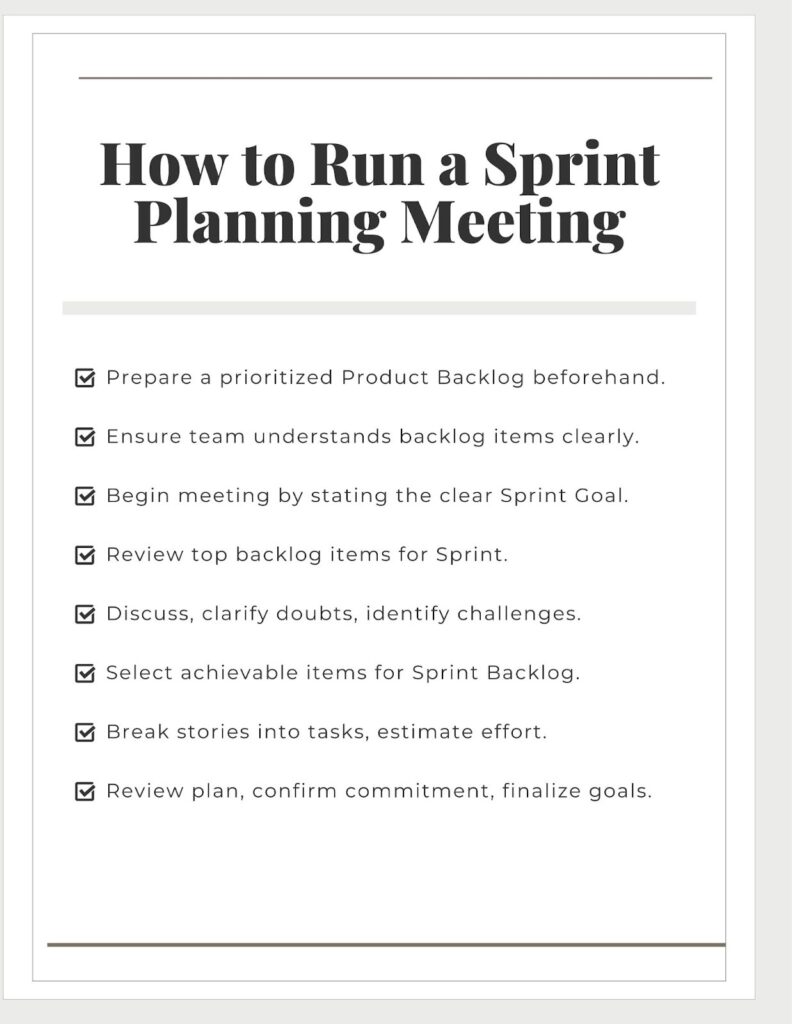
Step 1: Preparation
A great start leads to great results.
The PO’s Job: The Product Owner (PO) is the key player and initiator of this meeting. They must come with a prepared Product Backlog. The most important items at the top should be clear, detailed, and prioritized. It is like a menu of the team for the Sprint.
The Team’s Job: So, PO is involved in preparing this list. The team’s crucial job is to be already familiar with that backlog from previous refinement sessions.
Step 2: Set the Stage (First 15 Minutes)
Everyone is getting ready. Begin with the review goal.
Review the Goal: The Product Owner is the responsible person for kicking off the presentation of the Sprint goal. This is a short, clear statement of what the team aims to achieve by the end of the Sprint. For example, “Allow users to reset their password securely without needing to contact customer support.” This provides the team with a shared purpose, not just a list of tasks.
Review the Backlog: The PO then takes the team through the high-priority items from the backlog that could help achieve that goal.
Step 3: Choose the work (The “What”)
The team can set a realistic commitment to delivering.
Discuss and Ask Questions: The team reviews each potential backlog item. Developers and Testers may ask these questions:
- “What does ‘done’ look like for this?”
- “Are there any hidden challenges?”
Select the items: Collectively, the team decides how many of these top items they can realistically finish in the Sprint. This is a team decision, not a command from the PO or Scrum Master. The selected items move from the Product Backlog to the Sprint Backlog.
Step 4: Divide and Allocate it (The “How”)
Put plans into action. For each backlog item selected, the team needs to create a game plan.
Create a Task List: Breakdown each backlog item (usually a “User Story”) into small, specific, and actionable tasks. Let’s consider an example: the “password reset” story task list will contain:
- Create UI mockups for reset flow,
- Develop a backend API for password validation,
- Implement email notification service,
- Write integration tests for the complete workflow.
Estimate Effort: Most of the teams find this useful to calculate the time or complexity of these tasks. Make sure the workload is realistic and well-distributed among team members.
Step 5: Finalize The Plan
Before finishing, do you do a quick check?
Review the Plan: Take a final look at the Sprint Backlog.
- Does everyone understand the tasks?
- Does the plan look achievable?
Confirm Commitment: The scrum master responsible is getting the final confirmation from each team member that orally agrees to the Sprint Goal and the established plan. The powerful question Does everyone feel confident in our plan?” brings true team engagement.
Some Useful Tips For Success:
Follow these valuable, simple tips to become successful:
- Time-box it: A two-week Sprint usually requires a maximum of a two-hour planning meeting. Engage it focused.
- Invest in the Right Skills: Gain the required skills through the CSM certification course, which brings you a deep understanding of the Scrum practices and essential skills to run successful Sprint planning meetings.
- Ensure Everyone’s Participation: Not only for POs and Scrum Masters. This is for all team members. Encourage them to participate and make them involved in discussions.
- Deploy a Scrum Master to Facilitate: The Scrum Master should facilitate the entire meeting to avoid conflict in the discussions. Ensure the meeting is on track, remove roadblocks, and encourage team members to be cross-functional.
Final Thoughts:
Teams following an effective Sprint Planning meeting are achieving 80 to 90% of their goal as planned. Teams that have “successful” meetings are much more likely to complete their work on time and feel proud about what they have built. It sets an example for everyone to follow for a smooth and successful Sprint.


Success in today’s competitive business world requires more than just determination—it demands excellence. That’s where ExcellenceGet.net/ comes in. Designed for startups, digital marketers, and entrepreneurs, the platform delivers expert insights on business excellence, leadership strategies, and management solutions. Whether you’re looking to master the art of leadership or refine your digital strategies, ExcellenceGet.net/ provides the tools and resources to help your business thrive.
Why Excellence Matters in Business
Excellence isn’t just a buzzword—it’s the foundation upon which thriving businesses are built. It drives innovation, fosters creativity, and creates trust with customers and stakeholders. Committing to excellence early ensures a stronger, more sustainable foundation for startups and entrepreneurs. For digital marketers, prioritizing excellence sharpens campaigns and ensures higher ROI. At every stage, excellence differentiates successful businesses from their competitors.
Key benefits of pursuing business excellence include:
- Improving operational efficiency
- Building a strong, trustworthy brand
- Increasing customer satisfaction
- Driving consistent business growth
Excellence isn’t an option—it’s a necessity.
How ExcellenceGet.net Supports Your Business Growth
ExcellenceGet.net is a one-stop platform specifically designed to help businesses reach their full potential. With its comprehensive library of expert-curated content, the platform empowers you to face challenges, innovate, and grow with confidence.
Features and Tools Offered by ExcellenceGet.net
- Business Excellence Articles
- Leadership Resources
- Case Studies
- Exclusive Community for Entrepreneurs and Marketers
- Keyword Research
Use tools like Google Keyword Planner to identify terms that your target audience is searching for. Focus on long-tail keywords for better targeting.
- Content Optimization
Publish high-quality content that addresses customer pain points. Platforms like ExcellenceGet.net provide valuable insights into how to create impactful content.
- Technical SEO
Ensure your website is mobile-friendly, fast, and free of crawling issues. Tools such as SEMrush can help with diagnostics.
- Backlink Building
Focus on acquiring backlinks from industry leaders and related websites to boost your authority.
ExcellenceGet.net’s resources even include tips on SEO content creation tailored for startups!
Enhancing Digital Marketing Strategies with ExcellenceGet
Digital marketers require tools and insights that enable strategic, creative, and efficient execution. ExcellenceGet.net offers just that—actionable advice and proven tactics to enhance marketing strategies and boost campaign performance.
Ways digital marketers can benefit from ExcellenceGet:
- Learn how to craft high-impact campaigns that align with brand values.
- Discover tools to analyze campaign performance and refine targeting.
- Gain insights into creating share-worthy content tailored to your audience.
- Understand how to use customer feedback for continuous improvement.
With ExcellenceGet.net as your guide, you can elevate your digital marketing efforts and ensure excellence at every stage of a campaign.
The Future of Excellence in Business
The business of tomorrow will look vastly different from what it is today. Excellence will no longer be a differentiator—it will be the standard. Platforms like ExcellenceGet are at the forefront of this change, empowering businesses to adapt, innovate, and excel.
Here’s what the future of business excellence looks like:
- AI-Driven Decision Making
AI and machine learning will play an integral role in helping businesses implement smarter, more efficient strategies.
- Sustainability and Ethics
Companies pursuing excellence will increasingly prioritize ethical practices and sustainability.
- Personalized Leadership Approaches
Businesses will shift toward more personalized approaches in leadership and team management.
ExcellenceGet.net is dedicated to helping you and your business stay ahead in this rapidly evolving landscape.
Achieve Business Excellence with ExcellenceGet.net
Excellence isn’t achieved overnight—it’s the result of deliberate effort, expert guidance, and continual improvement. For startups, digital marketers, and entrepreneurs alike, ExcellenceGet.net offers the resources, tools, and community needed to thrive.
Explore ExcellenceGet.net today and take your business to the next level!
[Visit ExcellenceGet.net/ and Start Your Journey]
Conclusion
In this fast-paced and ever-evolving business landscape, achieving excellence requires a proactive approach, continuous learning, and the right resources. At ExcellenceGet.net/, we are committed to helping you and your business thrive, providing the tools, resources, and a supportive community needed to stay ahead. Embrace AI-driven decision-making, prioritize sustainability and ethics, and adopt personalized leadership approaches to unlock the full potential of your business. Start your journey towards business excellence today and explore everything ExcellenceGet.net/ has to offer. Together, let’s take your business to the next level!
[Visit ExcellenceGet.net and Start Your Journey]
FAQs
Q: What kind of resources does ExcellenceGet.net offer?
A: ExcellenceGet.net offers a wide range of resources to help businesses thrive. From articles and guides on various business topics to templates, frameworks, and tools, we provide comprehensive support to help you navigate the challenges and opportunities of the business world.
Q: Is ExcellenceGet.net/ only for startups?
A: No, ExcellenceGet.net/ is designed to support startups, digital marketers, and entrepreneurs of all levels. Whether you’re just starting or looking to take your established business to new heights, you will find valuable insights, resources, and a supportive community at ExcellenceGet.net/.
Q: How can I stay updated with the latest trends and insights?
A: ExcellenceGet.net/ is committed to keeping you informed and up-to-date. We regularly publish articles, case studies, and research papers on the latest trends, strategies, and best practices in business. Additionally, our community forums provide a platform for discussion and knowledge sharing among industry experts and fellow entrepreneurs.
Q: Can ExcellenceGet.net/ help with personalized leadership approaches?
A: Absolutely! At ExcellenceGet.net/, we understand the importance of leadership in driving business success. We offer resources and guidance on developing personalized leadership styles that align with your values and business goals. We aim to help you unlock your leadership potential and inspire your team to achieve excellence.
Q: How can I get involved with the ExcellenceGet.net/ community?
A: Joining the ExcellenceGet.net community is easy! Simply create an account on our website to gain access to our resources, forums, and networking opportunities. Engage with fellow entrepreneurs, share your experiences, and learn from others who are on a similar journey to business excellence.
Have more questions? Don’t hesitate to reach out to our support team. We’re here to assist you every step of the way on your path to business excellence.

Best Engineering Colleges in Qatar for 2026

How Losing Track of Time Can Extend Immigration Detention

Comprehend How Tokenization Enhances Security For Recurring Payments

How to Run a Sprint Planning Meeting?

Unlock Stunning Visuals in Seconds with This AI Image Generator

Oven Maintenance 101: Tips To Keep Your Oven In Top Shape For Long

ExcellenceGet.net/: Empowering Businesses to Excel

Yell51x-ouz4 for tiles: Revolutionizing Tile Projects

Why Hiring an Expert Lawyer Is Essential for Protecting Your Interests

Leveling Up Finance: Why Crypto Gaming Could Be the Industry’s Next Big Inflection Point

Condo Down Payment in Singapore- All You Need to Know

Cosmic Nootropic: A Comprehensive Review of Quality Cognitive Enhancers

The Benefits of Cosmic Nootropics and Why We Recommend Them

How Managed IT Services Enhance Business Information Security

Finding Love in the Digital Age: Exploring the World of Online Dating with ChatMatch

Why Hair Transplant Turkey is the Best Choice for Hair Restoration

Top Florida Cities to Visit for Spring Break 2024: Florida Vacation Rentals for Every Traveler

The Long-Term Effects of Meth: What You Need to Know

6 Intriguing Spanish Shows to Watch on Netflix

The Essential Guide to Truck Part Upgrades and Replacements: Enhancing Performance and Functionality

Chickvibess UK Cannabis: Redefining Wellness and Sustainability

Cindy Wodash AZ: Pioneering Sustainability and Adventure

Unlock Your Brain’s Potential with Cosmic Nootropics

1.5f8-p1uzt Texture: A Game-Changer in Interior Design

Whatsapp logicalshout: Mastering WhatsApp Business

Champagne Multivitamins Dominican Republic

326/21.8181818181: The Ultimate Guide to SEO for Small Business

What happened to ellen yarnell?

Tom Oar Obituary: A Tribute to Tom Mountain Men

Travelsfornow.com: Your Guide to Budget Solo Adventuring
-

 TECHNOLOGY2 years ago
M6 auc 4s0101 Chip: Revolutionizing Automotive Electronics
-

 NOODLEMAGAZINE2 years ago
NoodleMagazine: Bridging Cultures
-

 ENTERTAINMENT2 years ago
NoodleMagazine: Stirring Up Culinary Creativity
-

 HEALTH & FITNESS2 years ago
How NoodleMagazine is Shaping Modern Asian Cuisine Trends
-

 NOODLEMAGAZINE2 years ago
Discover the NoodleMagazine
-

 BUSINESS2 years ago
Ajay Attaho: Revolutionizing Freelancing, Tech, and Startups
-

 HEALTH & FITNESS2 years ago
How NoodleMagazine Inspires Home Cooks
-

 HEALTH & FITNESS2 years ago
The Top 5 Foam Play Mats Reviewed!